Bruce Townsend and Heidi Bundy, 2020 National Outstanding Tree Farmer of the Year Finalist
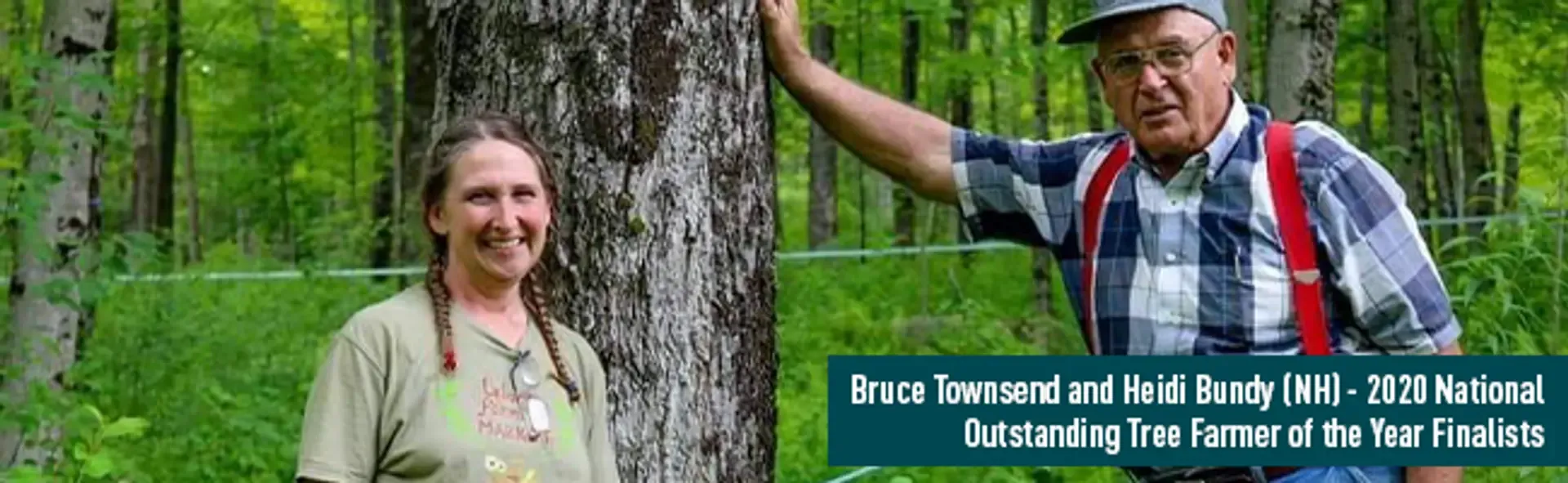
Bruce Townsend and his daughter Heidi Bundy own and operate Tomapo Farm in Lebanon, New Hampshire, on land that has been in their family for 250 years. Each generation has found ways to improve the property and enhance its productivity, while also supporting wildlife and enhancing recreation opportunities for their community.
“As a family, we have done our best to manage our forest sustainably,” Heidi says. “In 1953, my great-grandfather joined the American Tree Farm System. Those standards caused us to hire a forester to oversee the management of our land for better conservation and sustainability.”
Over the past 10 years, Tomapo Farm has produced roughly 500 MBF of sawlogs, 2,500 tons of pulpwood, and 500 cords of fuelwood. Until recently, Bruce performed all of the harvesting using a farm tractor.
Each year, the farm produces approximately 500 gallons of maple syrup from the 1,600-tap sugar bush. In addition to producing maple products, the family tends a nut orchard that was planted by Bruce’s great-grandfather more than 100 years ago. The orchard is also home to the Grafton County Champion butternut tree.
Management efforts emphasize maintaining mast and snag trees for wildlife and buffers to protect water quality. The property provides habitat for monarch butterflies and nest boxes for bluebirds. Every year, a colony of bats returns to roost in the barn.
“We feel that the greatest conservation accomplishment is the obvious health of our forest, which is attested to by the healthy increase of wildlife,” Heidi says. “My father says he never saw turkeys or evidence of bears when he was younger. Now, in addition to a very strong deer herd, we have a turkey herd typically 30 strong, black bears, bobcats, fisher cats, and coyotes, in addition to a plethora of birds and plants.”
Heidi and Bruce consider themselves stewards of the land and generously share it with their community for hunting, hiking, skiing, and snowshoeing. They keep a path mowed around the edges of their fields for the public to use. A ski area is sited on a 35-acre recreation easement with the City of Lebanon. Youth group visits and maple tours are regular events.
Tomapo Farm’s future is secure, thanks to a conservation easement. “Without conservation,” Bruce says, “there would be nothing for our children in the future.”
America’s family forests are vital for clean water and air, wildlife habitat, and sustainable wood supplies. The American Tree Farm System, the American Forest Foundation’s signature program, is the country’s largest sustainable woodland program, with a network of more than 70,000 family forest owners managing 19 million acres of forestland.
Related Articles
June 16, 2026
New Approach Could Help Solve One of Carbon Markets’ Biggest Problems
The American Forest Foundation, Beyond Alliance, and RMI today released findings that introduce a new legal and financial framework to manage risk for all carbon removal pathways that will bolster the integrity and scalability of the market.
May 28, 2026
Fighting Forest Invasives For A Healthier Future
Laura and Mike Jackson were among the first-ever landowners to enroll in the Family Forest Carbon Program (FFCP). As one of the 78 members of FFCP’s first cohort, they launched the program to become a current network of over 1,400 landowners stewarding over 200,000 acres of land across the Eastern United States. The Jacksons shared how the program has helped their forest goals these past 6 years.
May 13, 2026
Looking Back at Bear Town
FFCP caught up with Susan Benedict, our third-ever-enrolled landowner, to reflect on her six years with the program and what she is looking forward to in the future.