Advancing Credibility
The Family Forest Carbon Program takes a highly credible and transparent approach to the way we calculate our carbon benefit—ensuring meaningful and measurable impact.
Carbon markets are an important tool in addressing climate change, and program developers must work to improve their impact.
Enter the Family Forest Carbon Program.
We have developed a new forest carbon accounting methodology to measure and verify the carbon sequestered and stored by the landowners in our program. It brings the latest science together with innovative business models to provide a more accurate measurement of the carbon benefit.
Unlike other carbon credit methodologies, ours does not use a projected baseline. Rather, it uses a dynamic baseline. This means that our methodology compares the carbon sequestered on land enrolled in the Family Forest Carbon Program to highly comparable forests that are not enrolled in the program—in real time. By measuring the difference between the forests, our methodology can pinpoint the Family Forest Carbon Program as the variable that contributed to the carbon benefit—providing increased accuracy and transparency.
This new methodology is approved by Verra, the globally recognized nonprofit organization that oversees the Verified Carbon Standard (VCS).
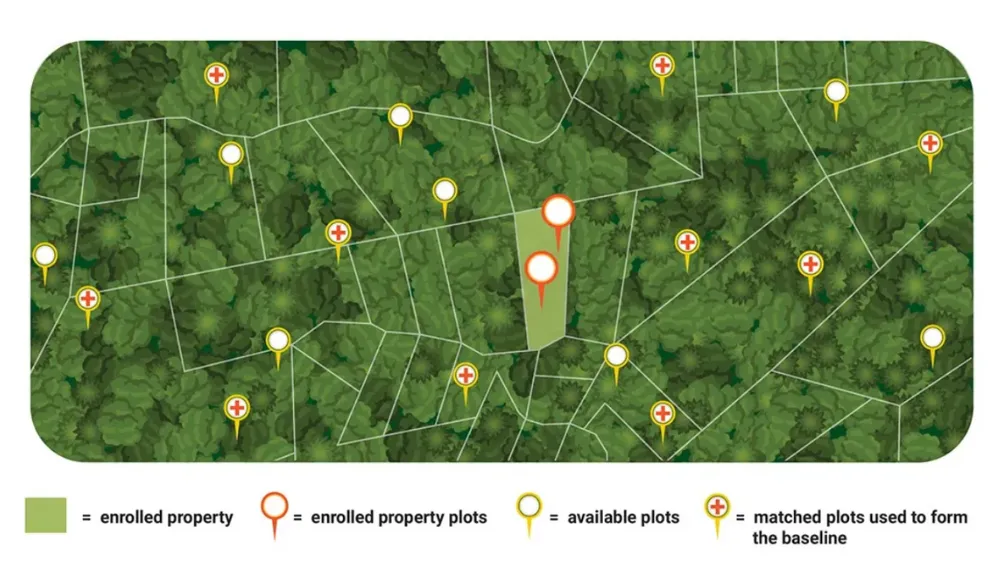
Establish a Baseline of Highly Similar Forested Properties Outside the Project Area
A dynamic baseline of highly similar unenrolled properties outside the project area is established. The unenrolled properties are selected using the U.S. Forest Service's National Forest Inventory and Analysis (FIA) database and are matched to enrolled properties based on a minimum of 14 variables, including ecoregion, land elevation and average width of trees.
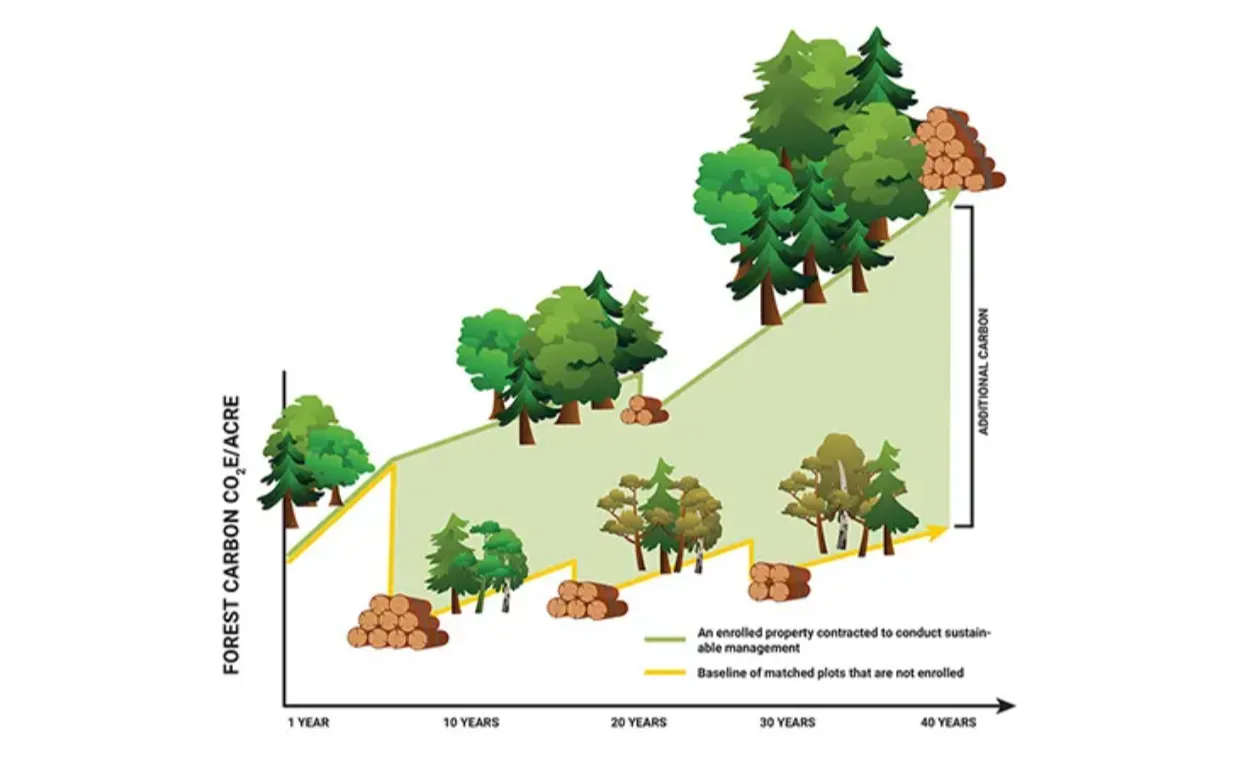
Compare the Carbon Sequestered on Enrolled Properties to the Baseline of Unenrolled Properties
To measure the carbon benefit of the project, enrolled properties are compared to the dynamic baseline of matched (unenrolled) forest plots. By measuring the difference between the forests, the methodology pinpoints the project as the intervention that contributed to the carbon benefit, providing increased accuracy and transparency to the marketplace.
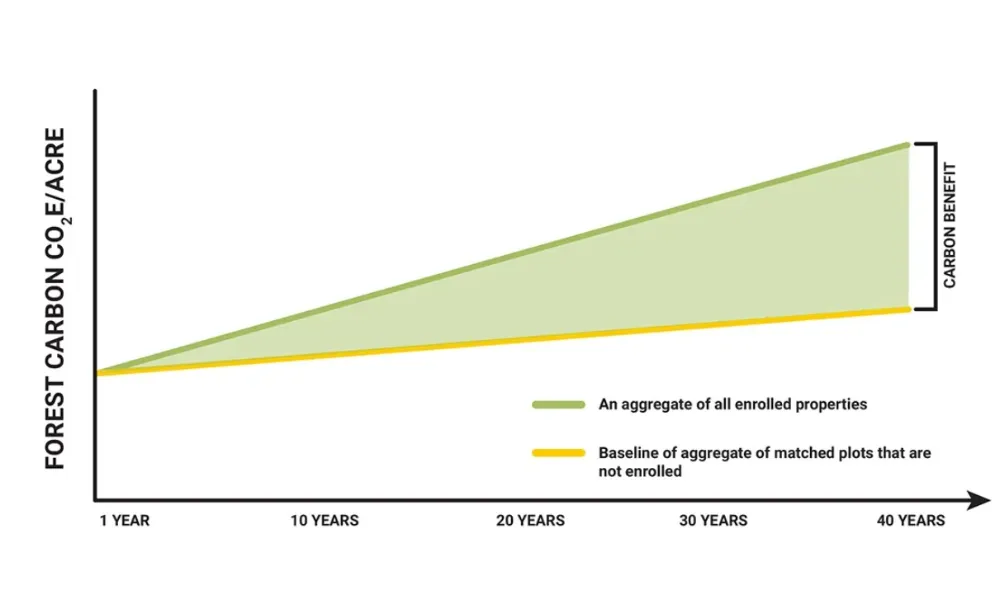
Calculate the Carbon Benefit at a Landscape Level
Enrolled properties in a region are aggregated, as are the matched plots that form the dynamic baseline. The difference between the enrolled properties and matched (unenrolled) plots is the amount of gross carbon attributed to the project which can then be sold in the form of verified carbon credits. This is calculated at each verification cycle.
Breaking Down the Terminology
Additionality
Additionality has occurred if the carbon generated from a forest carbon project resulted from the specific intervention. A project has additionality only if the carbon sequestration and storage would not have occurred absent the project.
Learn more about additionality.
Baseline
The baseline is the starting point for calculating how much additional carbon is sequestered and stored as a result of a particular carbon project. The Family Forest Carbon Program uses a dynamic baseline rather than the common projected baseline.
Permanence
Permanence ensures emissions are kept out of the atmosphere for at least 100 years. This is a critical attribute of a true carbon benefit. Emissions that are removed or reduced need to be permanently removed or reduced in order to meaningfully reduce CO2e in our atmosphere.
Scaling Impact Every Day
Our buyers and donors are vital to scaling the impact of the Family Forest Carbon Program.
2,510,000+
TONS CO2e STORED
585,000+
CAR EMMISSIONS OFFSET FOR ONE YEAR
26
CORPORATE PARTNERS