A Roadmap for Your Woods: How Forest Management Plans Help Landowners
Forest management plans give landowners a practical roadmap for making thoughtful decisions about their woods.
It can be easy to think of a woodland as something that simply takes care of itself, but every forest is always changing. Trees grow and compete, storms reshape the canopy, invasive species move in, wildlife needs shift, and family goals evolve from one generation to the next.
Owning a woodland is both a valuable investment and a long-term responsibility. A well-managed forest can generate income, provide quality wildlife habitat, protect important natural resources, and serve as a place where families make memories for generations.
Whether a landowner chooses active forestry practices or a more passive approach, those decisions can shape the forest for decades. A forest management plan (FMP) provides a roadmap for making those decisions intentionally. [1]
What Is a Forest Management Plan?
A forest management plan brings a landowner’s priorities and long-term goals together into a written set of recommendations for their property. While plans vary depending on the property and the organization or forester preparing them, an FMP generally includes: [2]
- Clearly defined goals for the land
- A description of the woods, with forest types divided into management units or “stands”
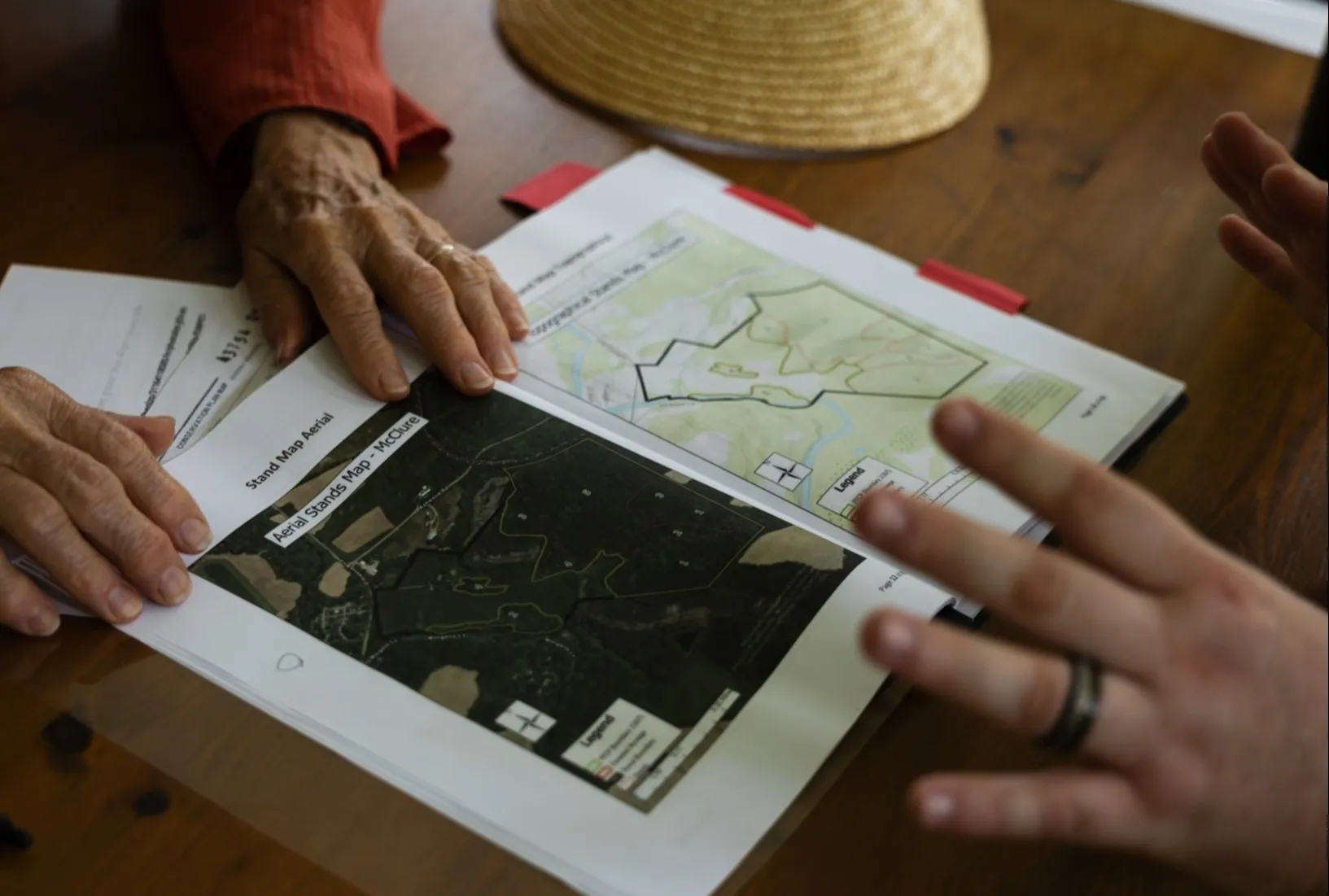
- Maps of the property, which may include forest stands, soils, aerial imagery, and topography
- Management objectives for each stand based on the landowner’s goals
- Strategies for improving current and future forest resilience to threats such as pests, pathogens, invasive species, climate change, and other stressors
Forest management plans typically look 10 to 20 years into the future, depending on geographic location and the type of plan. Rather than prescribing everything that must happen during that period, the plan provides direction for responding to changes in the forest over time.
It may establish a timeline for activities such as timber harvesting, tree planting, habitat improvements, or invasive-species control. Just as importantly, it explains why those activities may be appropriate and connects individual management recommendations to the landowner’s larger objectives.
Forest Management Plans and the Family Forest Carbon Program
One benefit of enrolling in the Family Forest Carbon Program (FFCP) is the option for landowners to receive assistance with developing a forest management plan for their woodland. [3]
Landowners may choose either a stipend toward a qualifying plan of their choice or a complimentary management plan provided through FFCP. The complimentary plans, referred to as “template plans,” are designed to satisfy FFCP requirements. Plans prepared by third-party foresters are generally more comprehensive and may also meet requirements for certain state tax or forestland programs.
For landowners enrolled in FFCP, the management plan can also help connect personal stewardship goals with program requirements, making it easier to understand how recommended activities support both the property and the broader goals of the program.
A Management Plan Starts With Your Goals
The first step in developing meaningful recommendations is understanding what the property means to the landowner and what they hope their forest will look like in the future.
Some questions worth considering include:
- Why do you cherish your woods?
- Are there special places or features on the property that are particularly important to you?
- Are you interested in promoting habitat for certain wildlife species?
- What recreational activities do you enjoy in your woods?
- Is timber management or income generation a priority?
- Are long-term plans such as a conservation easement, estate planning, or transferring the property to the next generation relevant to your woodland?
- Are there any activities or projects you would like to accomplish in the near future?
There is no single “correct” set of answers. One landowner may prioritize wildlife habitat; another may be interested in timber income, and another may simply want to maintain a healthy woodland for their children and grandchildren. Often, a landowner has several goals at once.
The management plan helps translate those goals into practical forestry recommendations.
Taking a Closer Look at the Woods
With the landowner’s objectives in mind, an on-the-ground assessment of the forest can be conducted. During this assessment, the forester evaluates characteristics such as:
- Forest types and tree species
- Approximate forest age and density
- Tree health, quality, and overall forest condition
- Evidence of invasive plants, forest pests, or pathogens
- Important habitat and natural-resource features
Forested areas are then divided into management units, commonly called stands. A stand is an area of forest with enough similar characteristics that can reasonably be managed using a common set of recommendations. [4]
For each stand, the management plan may describe:
- Forest type, tree species, size, quality, and health
- Desired future conditions
- Recommended management activities
- Invasive vegetation, forest pests, or pathogens that may require attention
- Habitat and natural-resource features such as wetlands or streams
Template plans also include adaptive management strategies for addressing larger-scale threats, including climate change and wildfire risk.
A Plan That Can Adapt Over Time
A forest management plan is not intended to lock a landowner into one course of action for the next 10 or 20 years. Forests are dynamic. Storms occur, markets change, invasive species appear, trees grow, and landowner priorities evolve.
Instead, an FMP provides a starting point for informed decision-making. As conditions change, landowners and foresters can revisit recommendations and adjust management while keeping the property’s larger goals in mind. [5]
Once the plan is drafted, landowners have an opportunity to review an FFCP management plan and make sure the content and recommendations reflect their priorities.
More Than a Plan for Cutting Trees
Forest management is sometimes associated primarily with timber harvesting, but an FMP is much broader than a proposal for cutting trees.
At its best, a forest management plan synthesizes a landowner’s vision for the property and considers the woodland as an entire ecological resource. It can guide decisions about forest health, wildlife habitat, recreation, timber, water resources, invasive species, climate resilience, and long-term stewardship.
It also creates a written record of the forest’s condition, goals, and management history. That information can be valuable not only to the current landowner, but also to children, grandchildren, or future owners of the property.

Key Tips for Landowners
- Start by identifying what matters most to you, such as wildlife habitat, recreation, timber income, family legacy, forest health, or conservation. (One landowner may want to improve deer and turkey habitat, while another may be focused on keeping walking trails open for family use.)
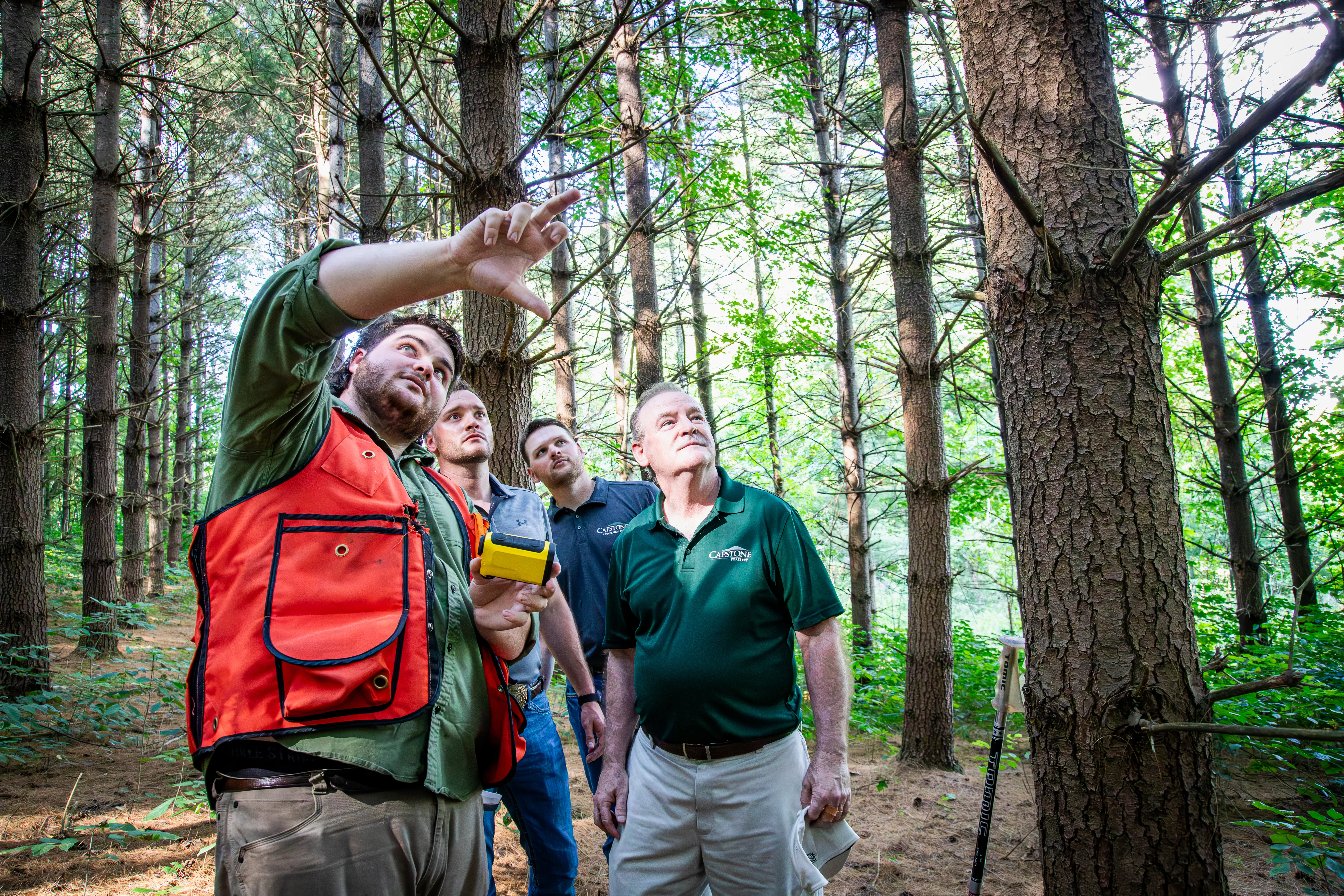
- Walk your property with a forester so the plan reflects real forest conditions, not just maps or records. [6] (A forester may notice invasive plants, poor regeneration, storm damage, or high-value habitat features that are not visible from aerial imagery alone.)
- Think of the plan as a guide, not a fixed script. Forests change, and your recommendations can be revisited over time. (A harvest recommendation may shift if a severe storm damages a stand or if new invasive-species concerns appear.)
- Ask questions about why each management activity is recommended and how it connects to your long-term goals. (Thinning may be recommended to improve tree growth, create better wildlife habitat, or reduce stress on the healthiest trees.)
- Keep the plan accessible for future reference, especially if the property may be transferred to family members or future owners. (The plan can help the next generation understand what work has already been completed and what priorities still need attention.)
A forest management plan can give you a clearer understanding of your woods and help you make informed decisions about its future. If you’re ready to explore what support may be available for your woodland, the Family Forest Carbon Program may be a good place to start.
Ready to take the next step?
Check Your Eligibility for the Family Forest Carbon Program and see if your woodland may qualify.
[1] https://www.fs.usda.gov/managing-land/forest-stewardship/program
[2] https://extension.psu.edu/forests-and-wildlife/forest-management
[3] https://familyforestcarbon.org/about-the-program/how-it-works/forest-management-plans/
[4] https://dnr.maryland.gov/forests/Pages/programapps/stewcon.aspx
[5] https://www.stateforesters.org/shared-stewardship/
[6] https://www.pa.gov/agencies/dcnr/conservation/forests-and-tree/managing-your-woods
[7] https://wvforestry.com/management-assistance/stewardship-program/
Related Articles
September 9, 2026
Is FFCP Right For You? Part 1: You Want to Work with People You Trust
The Family Forest Carbon Program is run by the American Forest Foundation (AFF), a trusted non-profit in forest conservation since 1932. In 2020, we partnered with the Nature Conservancy to launch FFCP, with the goal of giving small, private forest landowners access to the voluntary carbon market. The day-to-day operations of the program are run by AFF, and our team is made up of experts in forestry, finance, customer service, and fundraising, to name a few.

April 22, 2026
A New Way to Earn More from Your Forest: Introducing the Premium Partnership
Family forest owners have always balanced two priorities: doing right by their land and making sure it’s financially sustainable. Now, the Family Forest Carbon Program is expanding its offerings with a new opportunity that helps both, while putting more money in your pocket.

May 28, 2026
Beyond the Premium Partnership: Why Establishing a Farm Record Can Open More Opportunities
When we introduced the Premium Partnership, we focused on one of its most visible benefits: a contract value that is 25% higher than the standard Family Forest Carbon Program offer. But the value of this pathway extends beyond the upfront incentive.