Is FFCP Right For You? Part 3: You're Concerned About Greenwashing
This blog post is part of a four-part series called, “Is the Family Forest Carbon Program Right for You?” Scroll to the bottom of this article for links to the others in this series.
If you are someone who worries that forest carbon programs could (intentionally or otherwise) be exaggerating the impact they are having on the planet—you’ve come to the right place.
This idea of 'greenwashing’ is a real concern, and one we share as individuals who care deeply about the earth and America’s forests.
In this article we’ll look at how we know we are selling real, high-quality, verified carbon credits and how carbon markets—while not a perfect solution to climate change—allow us to do more with fewer resources.
Are We Enabling Corporate Polluting?
For decades, many companies around the world have looked for ways to reduce the carbon dioxide (CO2) that ends up in the atmosphere as a result of their business operations. The technology required to do this is incredibly expensive, and in some cases it does not yet exist.
While companies with a genuine desire to better the planet will start by reducing their emissions, the purchase of carbon credits—each representing one tonne of carbon dioxide removed from the atmosphere—is a common way companies deal with the CO2 that can’t yet be prevented from entering the atmosphere.
A quick illustration to explain the advantages of the carbon market:
Let’s say, hypothetically, that all the companies seeking to reduce their emissions have put into practice all the ideas that cost less than $10 per tonne.
But now they’ve run into a problem: the next level of ideas is going to be really hard and very expensive—at $100 per tonne. Some companies run the numbers and discover they can’t afford to do it and stay in business. What should they do?
Well, it turns out that forest landowners could, in theory, take more CO2 out of the atmosphere if they changed the way they manage their forests. It would cost them something, but it wouldn’t be nearly as much: $25 per tonne, let’s say. More than that first batch of techniques companies are already doing at $10 per tonne, but way less than the next set of ideas costing $100 per tonne.
Would it be better for those companies to a) spend $100 per tonne on reducing their own emissions, or b) should they pay the forest landowners to reduce their emissions instead?
In option A, the company spends $100, and there is one less tonne of CO2 for us to worry about.
In option B, the company spends the same $100, and there are four less tonnes of CO2 in the atmosphere.
This is the potential power of carbon markets: they allow companies to achieve more impact sooner, while research and technology continue to evolve and create more affordable solutions.
Vetting Our Corporate Buyers
It's important to note that carbon markets aren’t a solution by themselves. The above example only works if the companies actually do the work to reduce their emissions long-term. This is why FFCP sells its carbon credits only to companies who have made credible commitments to reduce their own emissions.
Paying Landowner for What They Were Going to Do Anyway
Some critics will suggest that programs like FFCP pay landowners to do something they would have done anyway (not harvest their trees). While some landowners who enroll in carbon programs may not intend to harvest, studies like this one show that intention does not always equal behavior, and when life happens—a medical procedure, a tuition payment, etc.—that unexpected financial need can often lead to an unplanned harvest.
And when landowners do cut trees, research shows they tend to over-harvest without meaning to. By enrolling in a program like FFCP, landowners are contractually obligated to delay harvesting, and receive annual payments instead to help offset the financial cost of not harvesting.
Additionality: The Additional Carbon Beyond “Business as Usual”
Even if the above is true, we need to be certain each credit we sell represents a real removal of carbon from the atmosphere.
This is the idea of “additionality”. Additionality speaks to whether the carbon stored on a woodland is additional—above and beyond what would have been stored on the land anyway.
To measure additionality, we created a unique approach to measuring, also known as our carbon accounting methodology. Other carbon programs compare the amount of carbon on an enrolled woodland to a projected or estimated baseline to determine additionality.
The problem with that approach is that it is based on assumptions that don’t always reflect real-life scenarios, so projections and estimates are often inaccurate, especially over long periods of time.
A Unique Approach to Carbon Accounting: Dynamic Baselines
Our method uses a dynamic baseline methodology, which compares the carbon stored on similar, unenrolled woodlands nearby and compares it to data from enrolled FFCP woodlands in real-time. If we measure carbon from FFCP-enrolled woodlands and compare it to the unenrolled woodlands and find there is no additional carbon, we do not generate a carbon credit. In contrast, other programs using a projected baseline would still issue a credit because their methodology is based on that estimate, regardless of what happens in reality.
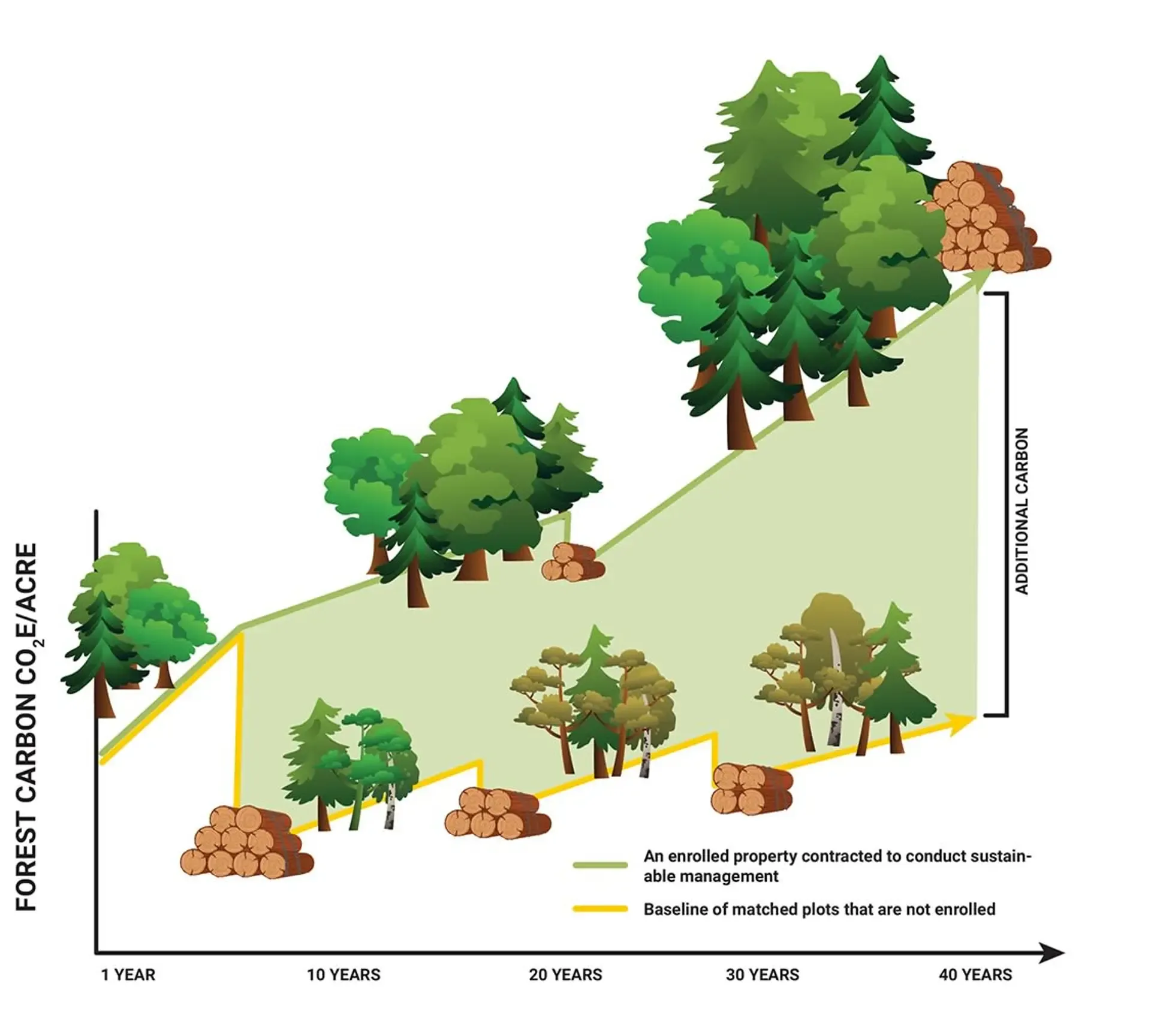
This approach is unique, rigorously tested, and verified by the world leader in carbon accounting. And while this methodology has become adopted by more programs, when we developed it for FFCP, it was a first-of-its-kind scientific technique. Because of its accuracy, it’s raising the bar and setting a new standard for carbon projects worldwide. You can read more about how our dynamic baseline is advancing integrity in the voluntary carbon market here.
Check out the other posts in this series here:
Related Articles
September 9, 2026
Is FFCP Right For You? Part 1: You Want to Work with People You Trust
The Family Forest Carbon Program is run by the American Forest Foundation (AFF), a trusted non-profit in forest conservation since 1932. In 2020, we partnered with the Nature Conservancy to launch FFCP, with the goal of giving small, private forest landowners access to the voluntary carbon market. The day-to-day operations of the program are run by AFF, and our team is made up of experts in forestry, finance, customer service, and fundraising, to name a few.
September 9, 2026
Is FFCP Right For You? Part 2: You Need Forestry Guidance
Landowners often want to do what’s best for their land, but may not have the expertise, or resources to take action. In this article, we’ll explore how the Family Forest Carbon Program (FFCP) provides the technical support you need to care for your woodland—with a long-term plan to help you avoid overwhelm and stay on track.
September 9, 2026
Is FFCP Right For You? Part 4: You Want to Know You're Getting a Good Deal
We know that money probably isn't the top priority when it comes to your forest, but it’s still important. If you’re like most landowners, you want to know that whatever you implement is going to be financially possible for you and your family, and that you’re not making an outright poor financial decision. In this article we’ll look at how the Family Forest Carbon Program (FFCP) is designed to protect you from market risk while increasing the long-term value of your forest.