Why Trust a Permanence Trust

The Permanence Trust concept is a bold solution to one of the thorniest problems facing the carbon market today: how can we ensure carbon projects from all pathways retain their claimed benefit both during and after the crediting period?
For the past few years, AFF has been refining the Permanence Trust concept from an idea to a detailed roadmap, culminating in our forthcoming feasibility study expected later this year. We've dissected how warranty fees would be priced, how a trust would interact with buffer pools, and incorporating lessons from operating our own project level Permanence Fund.
A common question we've heard from stakeholders is how any institution can be trusted to fulfill a mission hundreds of years into the future. Doing so would require a level of continuity and ironclad adherence to its mission that is unprecedented in today's carbon market — but not in other markets.
The Permanence Trust concept's success relies on borrowing proven practices from other institutions aiming to realize long-term financial goals. We specifically looked at:
-
Universities, hospitals, and NGOs that manage endowments over long time horizons
-
Hedge funds that constantly optimize and rebalance investment portfolios
-
Defined benefit contribution plans that provide liability guarantees
-
Insurance companies that deploy advanced risk modeling methodologies
-
Satellite monitoring to track carbon stocks and determine when a reversal has occurred
-
Equipment manufacturers that provide product warranties, which are increasingly covering longer time periods
-
Frameworks developed by carbon standards and industry bodies to ensure best carbon accounting principles are being followed
Like many organizations, the Trust will be a standalone, legally defined non-profit with its own board and governance. Its mission will be to support atmospheric integrity and climate mitigation by assuming non-permanence risk liability through a monetary fund approach. The Trust is designed to deliver on its responsibility by separating and reinforcing several core functions: governance, capital management, risk assessment, warranty issuance, monitoring, and claims response.
A governing layer of trustees or directors would oversee the Trust’s mission, with key responsibilities including defining the investment strategy and reviewing its performance, complying with laws and regulations, hiring service providers, and ensuring mission alignment and ethical behavior. The board would be supported by independent science and technical experts through multiple subcommittees to provide external review and accountability.
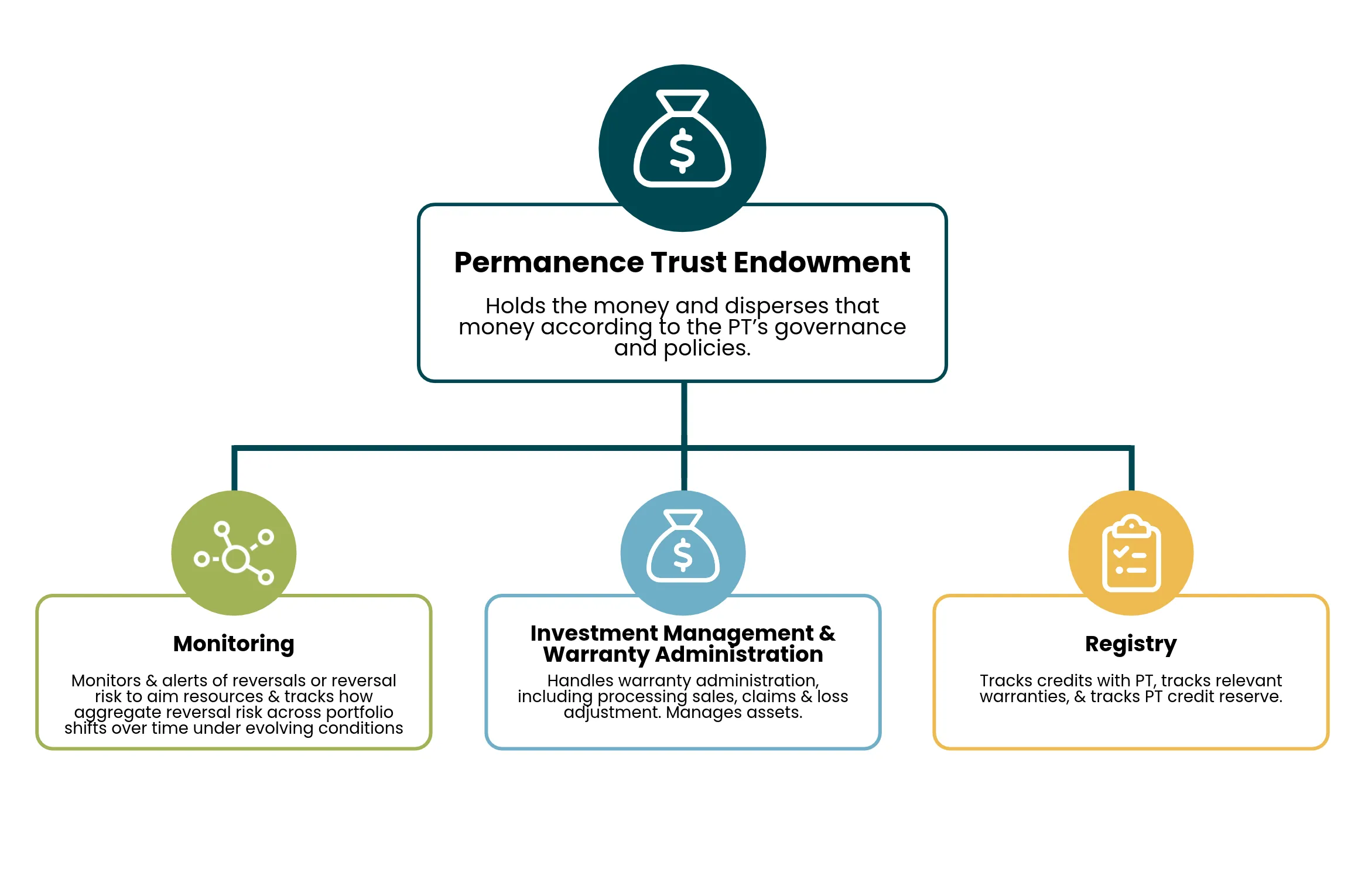
As a non-profit, mission-driven organization, it will be regularly audited, with annual financial statements shared publicly and transparently. Structuring the liability transfer as a warranty and tracking these issued warranties on a registry ensures a trust can legally guarantee the durable outcome indefinitely.
The portfolio of a permanence trust will constantly rebalance to optimize for risk management, including continued portfolio diversification. The Trust will select asset managers that are assessing the combined portfolio risks, the opportunity for mitigating that risk, the need to adjust warranty-related revenue, and triggers for retiring excess liability. Importantly, partners behind the Permanence Trust concept are exploring opportunities, particularly in the early years, for third-party guarantees to backstop projected warranty price revenue.
A Case Study in Perpetuity: Nuclear Decommissioning Funds
Nuclear decommissioning funds are one of the closest real-world analogues to what a permanence trust would need to achieve: financing obligations that may materialize decades or centuries after the original economic activity has occurred. Some specific mechanisms that a permanence trust would share include:
-
Prefunding future liabilities. Nuclear operators are generally required to accumulate funds during the operating life of a facility so that decommissioning costs are covered when the plant eventually closes. For a carbon project participating in a permanence trust, a warranty can be purchased for each ton of credited carbon, which would address the core problem that project developers do not hold long-term responsibility for carbon reversals.
-
Ringfenced assets. Nuclear decommissioning funds are typically maintained in independent trusts that are segregated from the operator's balance sheet and protected from creditors. Similarly, a permanence trust's assets would be legally separated from project developers so that funds survive bankruptcy, mergers, or project transfers.
-
Asset-liability matching. The nuclear sector does not simply accumulate cash — it manages long-term investment portfolios intended to meet long-dated obligations. A permanence trust could similarly hold long-duration assets, match investment strategy to the timing of expected reversals, and maintain liquidity for near-term replacement obligations while preserving growth for century-scale liabilities.
-
Governance focused on future beneficiaries. A subtle aspect of nuclear decommissioning is that the real beneficiary is not the operator but future society in general, which bears the risk if funding proves inadequate. Likewise, the trustees of a permanence trust owe duty to the atmosphere, which bears the consequences of a reversal . In nuclear decommissioning, the trust pays for cleanup. In carbon credit durability, the trust will need to purchase replacement credits to make the carbon sequestration claim represented by that carbon credit whole again after a reversal event.
While a permanence trust is different from nuclear decommissioning in some ways, including operating over longer liability time horizons and the uncertainty of predicting if/when a reversal occurs, the nuclear solution shows that achieving all this is possible without breaking the bank.
By looking to other industries and financial entities, we can develop a roadmap for managing long-term non-permanence risk. This infrastructure has been honed for centuries in other fields, and there's no reason the carbon market can't replicate it for our own purpose — guaranteeing the durability of our climate impact for generations to come. Trying something new always carries some risk, but the risk of hindering the market's growth when our planet needs it most is far greater.
Related Articles

September 14, 2026
New Report: Family Forests Provide Millions in Benefits to Businesses and Communities
Today, the American Forest Foundation (AFF) and Sorenson Impact Institute (SII) announced that forests managed by AFF’s Family Forest Carbon Program (FFCP) can provide millions in direct benefits and cost savings to businesses and communities.

June 16, 2026
New Approach Could Help Solve One of Carbon Markets’ Biggest Problems
The American Forest Foundation, Beyond Alliance, and RMI today released findings that introduce a new legal and financial framework to manage risk for all carbon removal pathways that will bolster the integrity and scalability of the market.
May 4, 2026
How to Navigate AFF's New Data Visualization Tool
By compiling several previously disparate data sources into one centralized map, the tool shows how the Family Forest Carbon Program, alongside communities, companies, and policymakers, can protect the health of family forests and unlock their environmental, social, and economic potential.